Select your country to get more accurate delivery dates and VAT.
Country
Language
Votre panier est vide pour le moment.
Your cart
There are no more items in your cart
The VAT will be optimized after the confirmation of your address, delivery method and VAT number. If the conditions are met the INTRACOM regime with VAT 0% will be applied.
Ces filtres seront appliqués tout au long de votre navigation, vous pouvez les désactiver à tout moment.
Categories
Flying Banner
Beach Flag, Flying Banner, drop flags, wingflags, Wind flag, ... There are many ways to call one of the most effictive advertising display ever created
Draw the public attention thanks to your splendid colour !
The advertising flag, also called Beach flag, is used outside as an eye-catcher.
Inside, it becomes very useful to differentiate yourself from the competition during a trade show, or simply to promote a product or a brand in your showroom.
Choose now between our 10 different models of advertising flag, or set up your own tailor made flag!
VEDI Beach Flag FAQ
Originally, the oriflamme was a long, tapered banner, the feudal standard of the Abbey of Saint-Denis adopted by the kings of France from the 12th to the 15th century. The name comes from the Latin "aurea flamma" (golden flame). Today, the term refers to a customisable advertising flag, shaped like a feather, teardrop or rectangle, used both indoors and outdoors to communicate a message.
None: they are common synonyms. You will also find the names Flying flag or Windflag for the same type of product.
In French, oriflamme is a feminine noun: you should say "une oriflamme", even though "un oriflamme" is frequently heard in everyday speech.
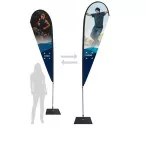
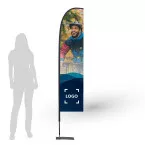
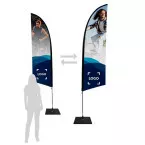
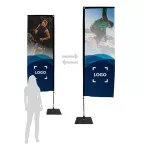
VEDI's current standard range comes in 3 shapes (Trapeze, Rectangle, Teardrop), 3 sizes (S/M/L) and 3 print types (Front, Back, Double-sided), with a choice of 7 different bases depending on the installation location. The teardrop shape is light and ideal for showcasing a logo; the trapeze (feather) shape is very straight and visible from afar, suited to sporting events; the rectangle shape, close to a classic poster, offers the largest print surface for text or several graphic elements. More unusual shapes also exist elsewhere on the market (tulip, triangle, flame, aeroplane wing), but are generally more expensive. Alongside this standard range, VEDI also offers the High Resistance Beach Flag range, a large-format, reinforced Trapeze format for locations very exposed to wind or at very high heights.
It is a large-format, reinforced range, distinct from the standard Trapeze/Rectangle/Teardrop range: at equal height, its sail is 45% larger than a classic Trapeze beach flag. It is available in 3 giant formats (L 415 cm, XL 465 cm, XXL 520 cm) and its ultra-stable base (flat base + base to fill with water or sand) can weigh from 54 kg (water) to 72 kg (sand), for good stability even in strong winds. Available in double-sided printing with a blockout layer between the two sails, it can be set up by a single person and comes with its transport bag. To be reserved for locations very exposed to wind or installations requiring a very large format.
It depends on the installation location: between 2 and 3.5 m for an indoor stand (fair, trade show), around 3 m for a shop front, and between 4 and 6 m for outdoor use (fair, large exhibition) where the flag must stand out among many exhibitors. The total height generally ranges from 175 cm to 500 cm.
The width is often expressed as a surface area (m²) rather than in cm, because it defines the actual size of the sail. The wider the flag, the more surface it offers for text and images, but its printing will also take more time.
Yes. The customer can personalise the height, width, sail material and pole finish. Custom sizes range from 30 x 30 cm up to 500 x 500 cm.
It consists of two printed sails (front and back) sewn together, with a blockout (a mesh of about 85 g/m²) placed between the two prints to avoid any transparency effect while keeping the sail flexible. It offers 360° visibility, a doubled print surface (and therefore the possibility of printing two different graphics), but costs more than a single-sided model of the same size.
Three main elements: the sail (the printed flag), the pole (rigid or telescopic support) and the foot or base (which stabilises the whole thing on the ground). A rotor (for rotation) and a strap or sleeve (to attach the sail to the pole) are often added.
Polyester is the reference material. There are three main weights: 110 g/m² (the most used, light, for indoor or occasional outdoor use), 120-130 g/m² (more versatile, better resistance to bad weather) and 200 g/m² or more (a plasticised look close to a banner, for prolonged outdoor use). You will also find commercial names such as Supralon (115 g/m², the most common), Trilobal (130 g/m², glossy, resistant to pollution) and Markelon (micro-perforated polyester, very durable).
It is a perforated polyester fabric, generally 110-130 g/m², which offers less wind resistance than a solid fabric while remaining very sturdy. Its drawback: the print goes through (visible in reverse on the other side), so classic double-sided printing is not directly possible.
It is a rigid panel material, used to give the flag the look of a panel rather than a flexible sail. It is reserved for indoor use (its wind resistance is too high outdoors), offers no transparency, allows highly detailed HD printing ("photorealism") and is fire-treated (M1 certification).
Depending on the shape chosen: sleeve (for the pole to pass through), carabiners, fixing eyelets, strap or Velcro fasteners. The seams are an important point of attention for the sturdiness and lifespan of the beach flag.
Three main materials: aluminium (light and flexible, the most common), iron/steel (heavier, sturdier but less flexible and prone to rust) and fibreglass (the most robust, best wind resistance, but also the most expensive). The pole can be in a single piece (sedentary use) or telescopic (easy to transport, for mobile use).
VEDI's current catalogue includes in particular: the 20-litre fillable base (with or without rotor), the 25 kg concrete base, the 40 kg High Resistance base, the ground spike (for soft ground), the cross base (for indoor use), the flat base (indoor) and the autocal. The choice depends on the type of ground (hard, soft, loose) and the installation location (indoor or outdoor).
In the current catalogue, this is the "20-litre base", available with or without an integrated rotor, to fill with water or sand to stabilise the flag by weight. Light and inexpensive when empty, easy to transport, it is classified among the "outdoor" products. Point of attention: the plastic can be punctured in case of a major impact, and you need water or sand on site to fill it.
The current standard model is the "25 kg concrete base". For a need for greater stability (large format, very windy area), VEDI also offers a "40 kg High Resistance base". These bases, classified as "outdoor", are recommended for sedentary use but remain difficult to transport due to their weight.
These two uses (a screw to sink into soft ground or a stake to plant) are today combined in a single catalogue product: the "ground spike", classified as "outdoor". It sinks into soft ground (sand, earth, snow) and is suitable for temporary or mobile installations; it is not suitable for hard ground.
In the current catalogue, this product is referenced as the "cross base" (classified as "indoor"). It is a folding, versatile and easy-to-transport base, but it requires flat, hard ground. Recommended mainly for indoor installation; outdoors, a ring buoy or a fillable base is often added for more stability.
A U- or V-shaped base that slides under a vehicle wheel: it is the weight of the car that stabilises the flag. Referenced as "Outdoor: Autocal" in the catalogue, it can be used both indoors and outdoors, but requires enough space to accommodate a vehicle (car dealerships in particular).
A bracket (called a "wall base" in the current catalogue, available at 0°, 30° or 90°) lets you fix a beach flag at height, along a post, a wall or a lamp post, without using a ground base. Recommended when ground space is limited or for permanent communication; the choice of angle (0°, 30° or 90°) depends on the support and the desired orientation for the sail.
Placed between the base and the pole, the rotor allows the flag to pivot freely with the wind, which reduces its wind resistance (and therefore its wear), stabilises the whole thing during gusts, and gives movement to the sail for better visual impact.
The term refers either to the side sleeve of the sail into which the pole slides, or to a strap (elastic or Velcro) that tensions the sail and prevents it from slipping or wrapping around the pole.
By checking: a base suited to the format and installation location (avoid low-end plastic for a large outdoor format), an aluminium pole with a fibreglass tip for good curvature, a sail of at least 110 g/m² with UV ink printing, careful finishes (hot cutting or double stitching to avoid fraying), a graphic of at least 50 dpi (no point exceeding 80 dpi on this support) and, ideally, a rotor system.
Both indoors (stand, trade show, counter, showroom) and outdoors (shop front, pavement, car park, fair), depending on the type of ground: hard (flat base, cross base, possibly weighted), soft (cross base without weight) or loose (ground spike).
Favour a maximum height of 2.6 to 4 m, a light sail (110-120 g/m², no need for thick fabric when sheltered from the wind), an aluminium pole and a "cross base" (with an optional weight buoy for large models). Assembly: place the base, unfold the pole in the sail's sleeve, then insert the whole thing into the base.
For an outdoor stand, plan for a beach flag of 4 to 6 m with a base suited to the terrain (weight bag recommended). For an indoor stand (such as a pop-up stand), a size of 2 to 4 m in teardrop or rectangle shape, on a "cross base", is more than enough.
Indoors, sheltered from the wind, a simple "cross base" (without weight) is enough. Favour a teardrop shape in 110 g/m² polyester not exceeding 3 m in height to limit the footprint. Installation takes only a few minutes.
Choose a sturdy fabric (110-120 g/m² for occasional use, heavier for sedentary use), a shape suited to the wind (feather, aeroplane wing), HD double-sided sublimation printing for 360° reading, and a fixing suited to the ground: fillable or concrete base on very hard ground, ground spike on earth or sand, flat base on smooth concrete. An aluminium pole with a fibreglass tip is recommended for prolonged use.
You must declare the occupation of public space to the town hall, install the beach flag on very flat ground, not obstruct pedestrian movement (people with reduced mobility, pushchairs), and choose a highly visible fillable base (over 20 kg once filled) to limit the risk of collision and ensure stability. The teardrop shape is recommended for its good readability and reduced ground footprint.
Yes, with a fixing system offering an angle of 20 to 45° from vertical (wall base at 0°, 30° or 90° in the current catalogue), fixed directly into the wall using plugs. Double-sided printing is then strongly recommended, because the printed message becomes visible on both sides of the wall (otherwise it appears in reverse through transparency on the unprinted side).
Any occupation of public space (pavement, park, beach) to install a beach flag requires authorisation from the town hall or the prefecture. You must refer to the local advertising regulations (RLP) of the municipality, or failing that seek advice from the prefecture.
It varies by model. On the current Trapeze and Rectangle beach flags for example, the sail + pole assembly withstands wind up to 6 Beaufort (39 to 49 km/h) for sizes M and L, and up to 7 Beaufort for size S. For locations very exposed to wind, the High Resistance Beach Flag range offers better stability thanks to its base which can weigh from 54 to 72 kg once filled. In all cases, beyond the limit indicated on the pole, it is essential to dismantle or bring in the flag, otherwise it may tip over or the pole may break.
Follow 4 rules: very flat ground, a base suited to the type of ground, letting the pole pivot freely (thanks to the rotor, without it rubbing against a wall or furniture), and dismantling the flag as soon as the wind exceeds the speed indicated on the pole. Professional civil liability insurance is also recommended.
The base and pole can last over ten years, but the textile sail is a consumable subject to wear from wind, sun and rain (outdoors), and must be renewed periodically. If a part breaks (pole, rotor, base), it is possible to replace only the damaged element, as the parts are compatible with each other. The sail can be cleaned with a vacuum cleaner to revive the colours.
Yes, the exhibitor's liability (retailer, restaurateur, organisation) can be engaged in case of an incident in public space. Municipal authorisation and professional civil liability insurance are strongly recommended to guard against this risk.
Each beach flag is generally delivered with a dedicated transport bag (supplied free of charge or as an option), which protects the sail from friction and separates the different parts (sail, pole, base) to prevent them from damaging each other.
According to the height of the beach flag: about 94 x 23 x 3 cm for under 2 m, 106 x 13 x 5 cm between 2 and 4 m, and 145 x 13 x 5 cm above 4 m. Also check the padding, the pockets and the zip closure.
Thermal sublimation is the reference technique for the polyester textile of beach flags. Digital inkjet printing is also commonly used. Other techniques exist for other advertising media (screen printing, embroidery, pad printing, laser engraving) but are less suited to a beach flag sail.
A process where the ink passes directly from solid to gaseous state under the effect of heat (180-210°C) to embed itself in the polyester fibre. Result: bright and durable colours, a sail washable at 30°C without cracking or fading, an ecological process (low CO² emissions) and a reduced production cost.
Three main advantages: instant drying by UV radiation (productivity gain of about 20%, no dust deposit during drying), high-definition print quality with a good gloss and resistance finish, and a more ecological process (no VOCs, long-life LED lamps, reduced energy consumption).
PDF is recommended to preserve the layout and check a preview before printing. PNG is preferable for logos, images with transparency or text (no loss of quality, but a heavier file). JPG is suitable for photos and simple graphics but tolerates enlargements less well (no more than 15%) and is not ideal for text. The recommended resolution is between 50 and 150 dpi.
A template is a ready-to-use mock-up that automatically respects the safety margins, the bleed and the CMYK colour mode suited to the exact dimensions of the chosen beach flag. It helps avoid sending a file that cannot be printed, without needing a professional graphic designer.
Six main rules: have a clear concept, keep it simple (avoid overloading with elements), stay universal and understandable by as many people as possible, play with sizes and transparency to create depth, use colours sparingly, and avoid overly busy fonts (two fonts maximum, legible).
The production time (printing the graphic) is generally 4 days for standard printing, longer for double-sided or a large surface. For delivery in France: about 3 days with the Eco option, 48h in Express or Express Secure (refunded if the deadline is not met). In total, allow one to two weeks between the order and receipt.
According to the current product sheets: the Trapeze Beach Flag (3 sizes, 7 bases to choose from, front or double-sided) starts at €89.50 excl. VAT, the Rectangle Beach Flag at €92.50 excl. VAT, and the High Resistance Beach Flag (large format, ultra-stable base, double-sided) at €153 excl. VAT. These base prices correspond to the smallest size and do not necessarily include the base (sold separately, from €19.80 for a rotor alone to €107.10 for the 40 kg High Resistance base; a High Resistance Trapeze XXL pole alone costs €77.40 excl. VAT).
Yes, it is possible to buy only the flag (sail) separately to refresh your graphic or change your message, without buying the base and pole you already have, provided they are compatible.
VEDI is based in Gosselies, in the Charleroi area (Hainaut), where a showroom lets you discover the different shapes and sizes of beach flags for real before ordering. The order and personalisation of the graphic are then done online via the Creator tool, with fast delivery thanks to the proximity of our workshop.
From Gosselies, in the heart of Hainaut, VEDI easily delivers throughout Wallonia: Namur, Liège, the province of Luxembourg or the rest of Hainaut. Remember to check the local rules with your municipality if you install the beach flag in public space.
Our Gosselies workshop is located less than an hour from Brussels, which allows fast delivery throughout the Brussels region. The order is placed entirely online, with dimensions and graphic personalised via the Creator tool.